

In the pet nutrition industry, probiotic supplements are undergoing a transformation from "concept addition" to "active promise". However, a frequently overlooked reality is that what consumers ultimately consume is not the strain name, but the number of live bacteria. Every step along the chain from the manufacturing workshop to the pet's feeding bowl is testing the fragile vitality of the Probiotics. This article will focus on the five core variables of temperature, moisture, oxygen, Packaging barrier properties, and storage conditions, and attempt to reveal a core viewpoint - that the manufacturing process and packaging design are never independent propositions; they jointly determine the final activity of the product. **
The sensitivity of probiotics to temperature far exceeds that of most pet food ingredients. At the production stage, the freezing-drying (freeze-drying) process is currently the mainstream method for protecting live bacteria, but the process itself is full of contradictions: too fast freezing rate will damage the cell membrane, while too slow freezing rate will result in overly large intracellular ice crystals. More importantly, if the residual moisture activity of the dried material is not properly controlled, even the slightest temperature fluctuation will trigger the activity of residual enzymes, accelerating metabolic consumption.
In the distribution stage, the cumulative effect of storage and transportation temperatures is far more lethal than a single high-temperature point. For example, if a product is exposed to a 40°C environment in a summer transport vehicle for 4 hours, its activity loss may exceed that of being stored in a 25°C constant temperature warehouse for three months. It is recommended that enterprises establish a "temperature-time cumulative damage model" instead of simply marking "cool and dry" as a simple solution. For soft chew tablets containing probiotics, if the granulation temperature during the Production Process exceeds 60°C, even if it lasts only a few minutes, it will cause irreversible damage.

Many formulators are accustomed to monitoring the total moisture content of materials, but moisture activity (Aw) is the true indicator that determines the survival rate of probiotics. When Aw is above 0.2, lipid oxidation within the cell membrane and enzymatic reactions will significantly accelerate; while when Aw is below 0.1, it may cause the cell membrane structure to collapse and prevent rehydration from restoring permeability.
Key control points in production include:
- Determining the freeze-drying endpoint (Aw must be monitored online, not just by time)
- Controlling the environmental dew point (especially during tabletting or filling, the relative humidity in the workshop should be ≤ 30%)
- The addition amount of wetting agents (such as glycerol and sorbitol) in the raw materials - although they can improve the taste, they will inadvertently increase Aw
> Key point: Under the same formula, when Aw increases from 0.15 to 0.25, the decay rate of viable bacteria at room temperature may jump from 30% to 75%. This reminds us that the design of packaging material's moisture-proof properties must correspond to the Aw target value of the product, rather than simply benchmarking against competing products.
Most Pet Probiotics (such as lactobacilli and bifidobacteria) belong to anaerobic or facultative anaerobic bacteria. Oxygen induces the accumulation of reactive oxygen species (ROS), which damages DNA and protein synthesis, and this damage is even more difficult to repair in a low moisture environment. The exposure risks during production include:
- Air is mixed during the mixing process (vacuum or nitrogen-filled mixing should be adopted)
- The material remains in the hopper for a long time during tablet pressing (turnover time needs to be controlled)
- Residual oxygen content in packaging (topspace oxygen ≤ 2% is the basic threshold)
A new perspective worth noting is to use oxygen-absorbing agents in the packaging or adopt oxygen-barrier inner layer materials (such as EVOH co-extruded film), but it must be noted that the oxygen-absorbing reaction will release a small amount of moisture, which conflicts with the moisture-proof requirement. This is a typical scenario where manufacturing and packaging need to be designed collaboratively - simply enhancing one aspect may lead to a trade-off.
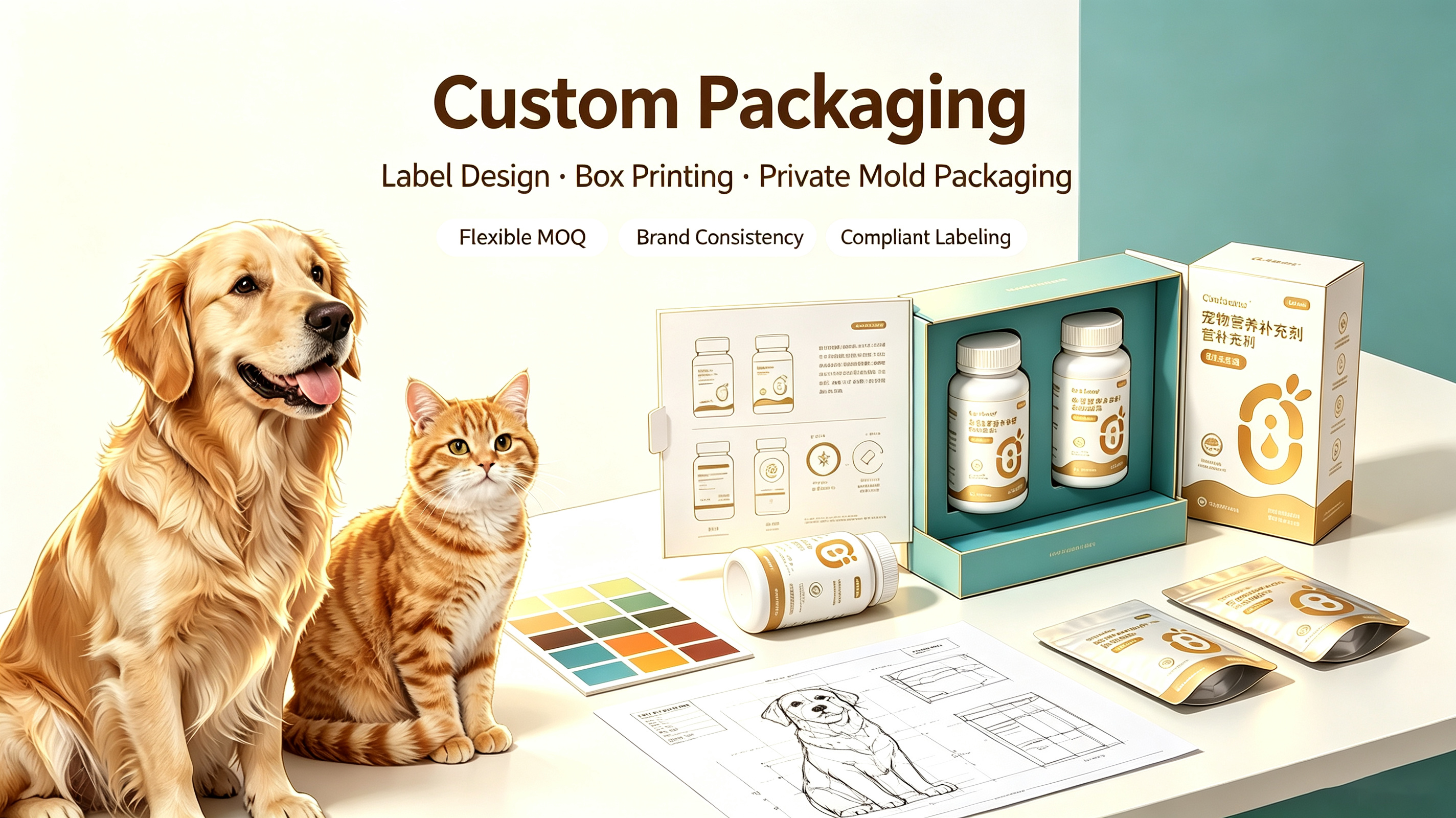
The water vapor transmission rate (WVTR) and oxygen transmission rate (OTR) of packaging are two crucial indicators, but companies often fall into the trap of choosing the most expensive materials. The actual decision should be based on:
1. Product Shelf Life requirements (12-month and 24-month requirements are completely different)
2. Climate zones of the sales area (tropical regions need to focus on moisture prevention, while dry regions need more oxidation prevention)
3. Re-sealability after opening (pet food is often used multiple times, and each opening introduces new oxygen and moisture)
Aluminum foil composite bags perform exceptionally well in barrier properties, but they are costly and prone to cracking; coated silicon oxide transparent film has good visibility, but its barrier properties are sensitive to temperature and humidity and are not suitable for markets with imperfect cold chain. For bottled products, in-seal bottle cap lining and dual-layer package of desiccant/oxygen absorber are a highly cost-effective collaborative solution - but this requires the filling line to have the ability to automatically insert the packages, which is a pre-arrangement at the manufacturing end.
Even if the production process is flawless, the temperature and humidity fluctuations during storage and retail (such as condensation on the inner walls of the packaging due to the temperature difference between day and night) often prove to be the final straw that breaks the back of the viable bacteria. Experimental data shows that products stored at a constant 25°C, if subjected to a 10°C to 30°C temperature cycle once a week, their aging rate is equivalent to 1.8 times that at a constant 30°C.
For the e-commerce channel, it is recommended to embed temperature indication labels in the packaging boxes. Although this does not directly enhance stability, it can provide a traceability basis for the logistics quality. At the same time, the instructions should clearly inform consumers that "After taking out, immediately seal it and do not divide it into ordinary containers without drying function" - this detail is often overlooked, but it directly affects the end-user experience.
The stability of probiotics is never a "material issue" or a "process issue", but a system coupling issue. The most superior freeze-drying process, if paired with incompatible packaging materials, will be a complete failure; the highest-grade aluminum foil bag, if the environmental humidity is out of control during filling, will also not guarantee the activity.
The future competitive point lies in whether enterprises can establish a "full-chain data link from the freeze-drying machine to the pet bowl", linking production parameters (freeze-drying curves, environmental dew point, mixing speed) with packaging specifications (material, thickness, sealing strength) and logistics predictions (temperature range, duration, fluctuation amplitude). Only in this way can one provide real and verifiable confidence behind the promise of "XX billion live bacteria" on the product label.
> Core Conclusion: Manufacturing gives probiotics their "initial vitality", while packaging determines how this vitality evolves over time. Neither is more prioritized; only one is incorporated into the same design blueprint. For Pet Supplements, the essence of stability management is to use engineering-based systematic thinking to counter the inherent vulnerability of microorganisms.
WhatsApp: +8613455471839
Email: sales@koalapetbio.com


This website uses cookies to ensure you get the best experience on our website.



 Phone
Phone
Comment
(0)