

Today, in the rapidly growing pet probiotic market, "CFU" (Colony Forming Units) has become a core selling point in the marketing copy of all major brands. Whether it's cat or dog food, nutritional gels, or specialized Probiotic Powders, the bold "XX billion CFU added" printed on the Packaging is often the direct motivation for consumers to make a purchase.
However, as a product manager, purchasing director, or Quality Control officer of a Pet Brand, if you only focus on the "production figure" that looks nice on paper and ignore the actual data at the "end of Shelf Life", then your product is likely experiencing a silent decline from an "effective product" to an "ineffective one". This article will clarify the differences in CFU between these two key time points and tell you how to find the real "calming assurance" in the supplier's documents.
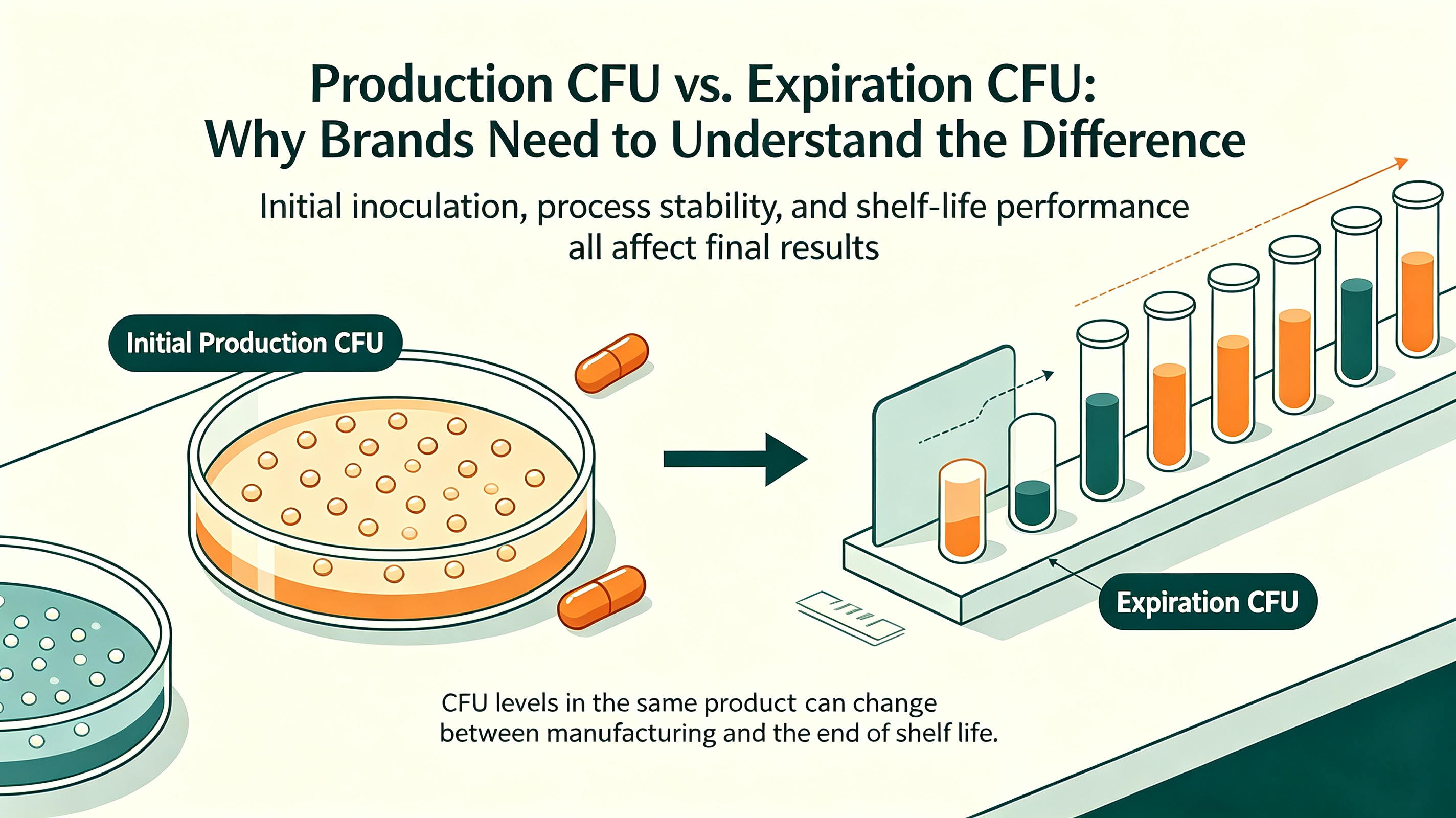
The CFU at production (initial viable bacteria count) :refers to the number of viable bacteria presented in the factory's mixed, pressed, or sealed packaging after the raw materials are mixed and the process is completed. This figure is the theoretical "starting point". Since the strains have not yet undergone temperature fluctuations, moisture contact, and oxygen erosion at this time, this number is often the "highlight moment" throughout the product's life cycle.
The CFU at the end of shelf life (shelf life guarantee value) :is the number of viable bacteria that can still be detected in the product on the last day of the specified shelf life (usually 18-24 months), under the specified storage conditions. This is the actual effective dosage that the pet can consume when the product is opened by the consumer.
The core logic is as follows: Probiotics are living microorganisms, and they will die. From the moment they are produced, even if stored in the refrigerator, the number of live bacteria will show a logarithmic decline. If during the Formulation design, only the CFU at the time of production is used as the basis for efficacy, while ignoring the decay curve within the shelf life, then the product may no longer reach the claimed threshold of effectiveness three months after leaving the factory.
Many OEM/ODM manufacturers habitually include "CFU at production" as a specification parameter when providing quotations and specifications. This is not wrong, as it is the starting point of quality control. However, the problem lies in that some suppliers deliberately blur the "decay rate within the shelf life".
Special pain points in the pet market:
1. Long supply chain cycle: From raw material procurement, production scheduling, arrival in storage, distribution to channel warehouses, and finally on the shelves for sale, this process often takes 3-6 months.
2. Uncontrollable storage and transportation conditions: Although the packaging indicates "store in a cool and dry place", the temperature of the logistics vehicle box can reach over 50°C in summer, and the shelves at the end may also be heated by light exposure. Without the support of strict encapsulation technology, the CFU at production may have been reduced by more than half by this stage.
3. Over-promising risk: If the brand prints 500 billion CFU directly on the main picture of the packaging and consumers find poor results after purchase, the repurchase rate drops. The root of the problem is often not that the strain is poor, but that the bacteria that are about to be consumed are already dead".
As the purchasing party, you don't need to be a microbiologist, but you must know where the "anchor point" is. The following three documents are the details you must insist on checking:
Don't just look at the line "≥100 billion CFU/g". Please look for the following two key commitments in the specification sheet:
- Shelf life endpoint value: Require the supplier to clearly indicate "At the end of the 24th month of shelf life, in an unopened state, the number of live bacteria is not less than X billion CFU/g". If the specification sheet only writes the initial value at production, ask for the addition of the shelf life endpoint value.
- Challenge test data: Ask the supplier if they have done accelerated stability tests (usually at 37°C/75% humidity to simulate the shelf life). If the decay curve graph provided by them shows a steep drop in the first three months, it indicates that the encapsulation process (such as freeze-drying protectants, microcapsule encapsulation) is not up to standard.
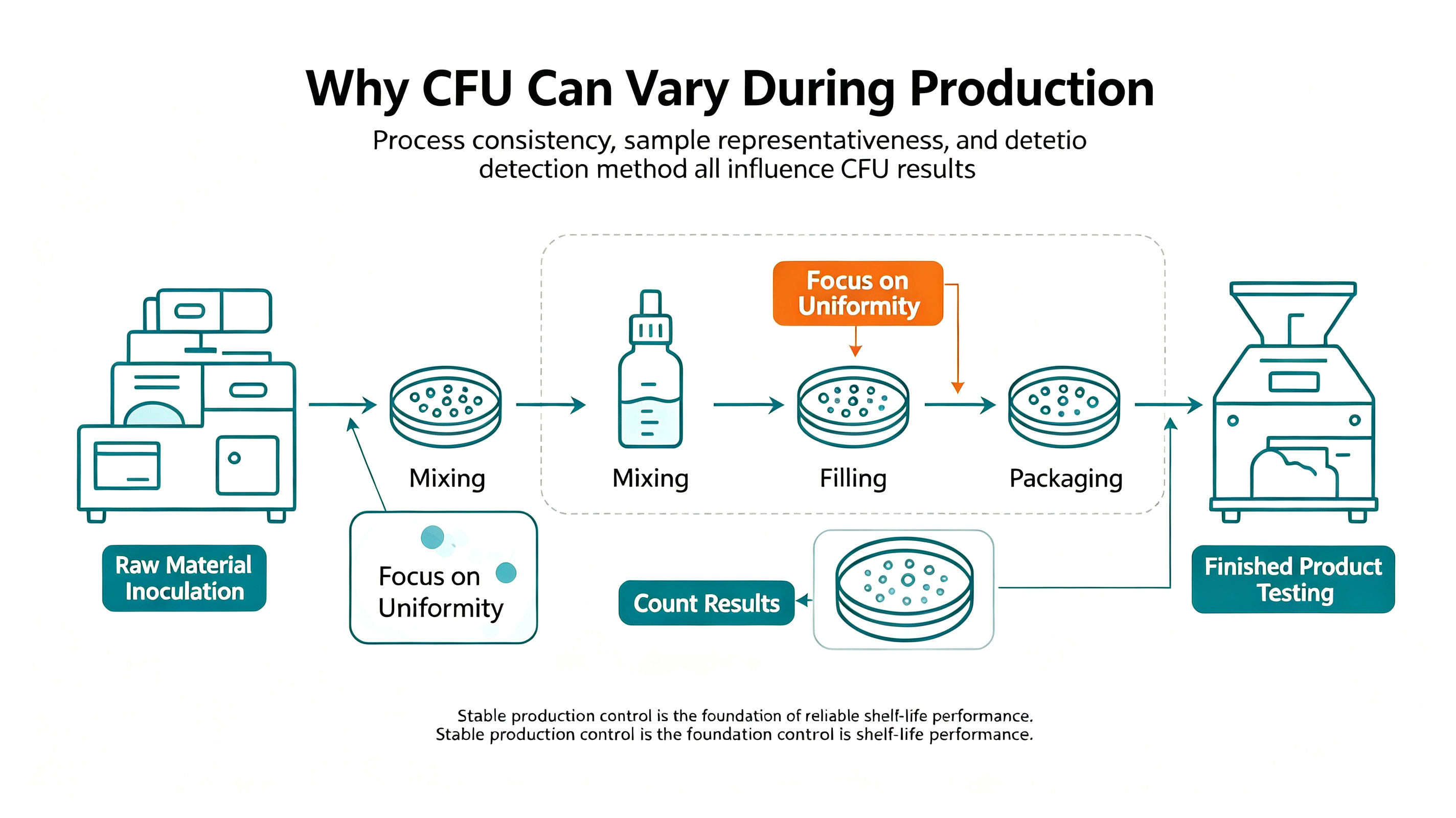
Each batch of goods leaving the factory comes with a COA, which reflects the actual production quality of this batch.
- Check the testing method: Confirm that the testing method is the internationally recognized agar plate counting method, and the dilution solution contains reducing reagents (such as L-cysteine), which can ensure that the test results are closer to the actual number of live bacteria.
- Be alert to "just meeting the standard": If the test value of the submitted sample just hits the lowest line in the specification sheet, and this lowest line is the initial value at production, please classify this batch as "high-risk batch". It is recommended to stipulate in the contract: The test value at the factory must be 2-3 times higher than the shelf life endpoint guarantee value (to reserve margin for decay).
This is the direct line of legal red line facing consumers.
- The annotation "*" must be marked: It is recommended to add a sentence on the back of the packaging: "The live bacteria count refers to the amount added during production. Due to transportation and storage, the actual number of live bacteria reaching the pet's intestines may vary." Although this sentence may reduce the sales persuasiveness, it can effectively avoid lawsuits from professional counterfeiters due to "insufficient live bacteria count".
- Distinguish between "added amount" and "guaranteed amount": Mature probiotic brands internationally usually mark "Potency Guaranteed Through Expiry" on the front (e.g., "Efficacy Guaranteed Until Expiry"). If your formula cannot achieve this, avoid only marking a single numerical value in a prominent position on the front. Otherwise, if market supervision conducts random inspections of products after the expiration date, there is a high risk of administrative penalties for "inconsistent content".
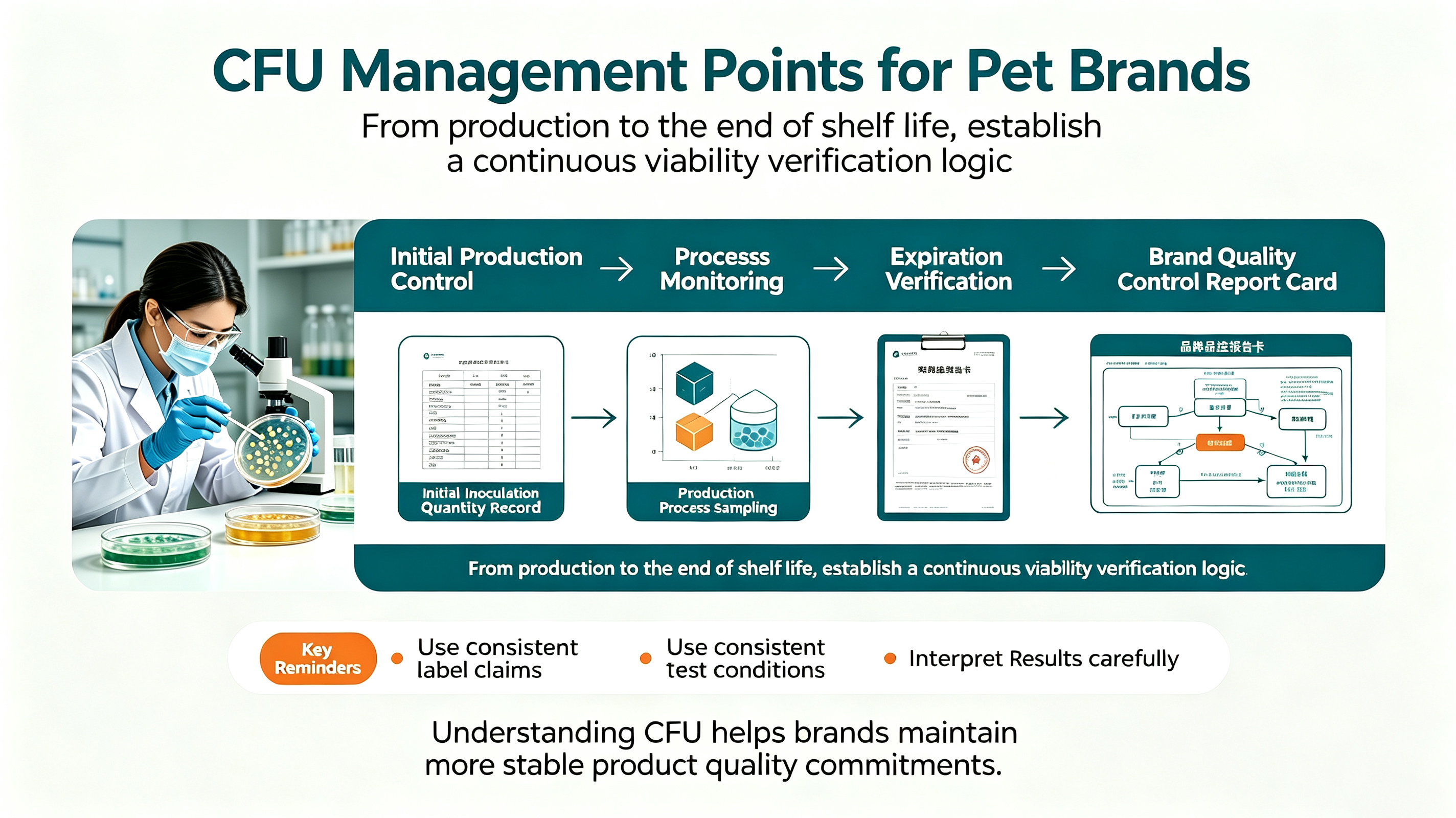
When signing the OEM contract, "CFU at the end of the shelf life" is set as the core KPI for quality acceptance. For example: If your product claims to contain 50 billion CFU per particle, then the supplier is required to ensure that there are at least 30 billion CFU remaining at the end of the shelf life. This forces the supplier to use higher-quality and more expensive freeze-drying protectants or oil-based embedding carriers.
Do not rely solely on the stability reports provided by the suppliers. As the brand owner, you should purchase commercially available products and send them to third-party institutions (such as SGS or Eurofins) for the detection of viable bacteria numbers in the 6th month and 12th month after shipment. This piece of data is more persuasive than any commitment from the suppliers and can also provide you with the basis for making a decision on whether to change the formula in advance.
On the detail page, it is rational to mention "The activity of the The activity of the strain is dynamically changing" and guide consumers to "Store it in the refrigerator immediately after receiving for a slower rate of decay" to slow down the deterioration process. This honesty can actually increase consumers' trust, making them understand that your brand understands technology and values effectiveness.
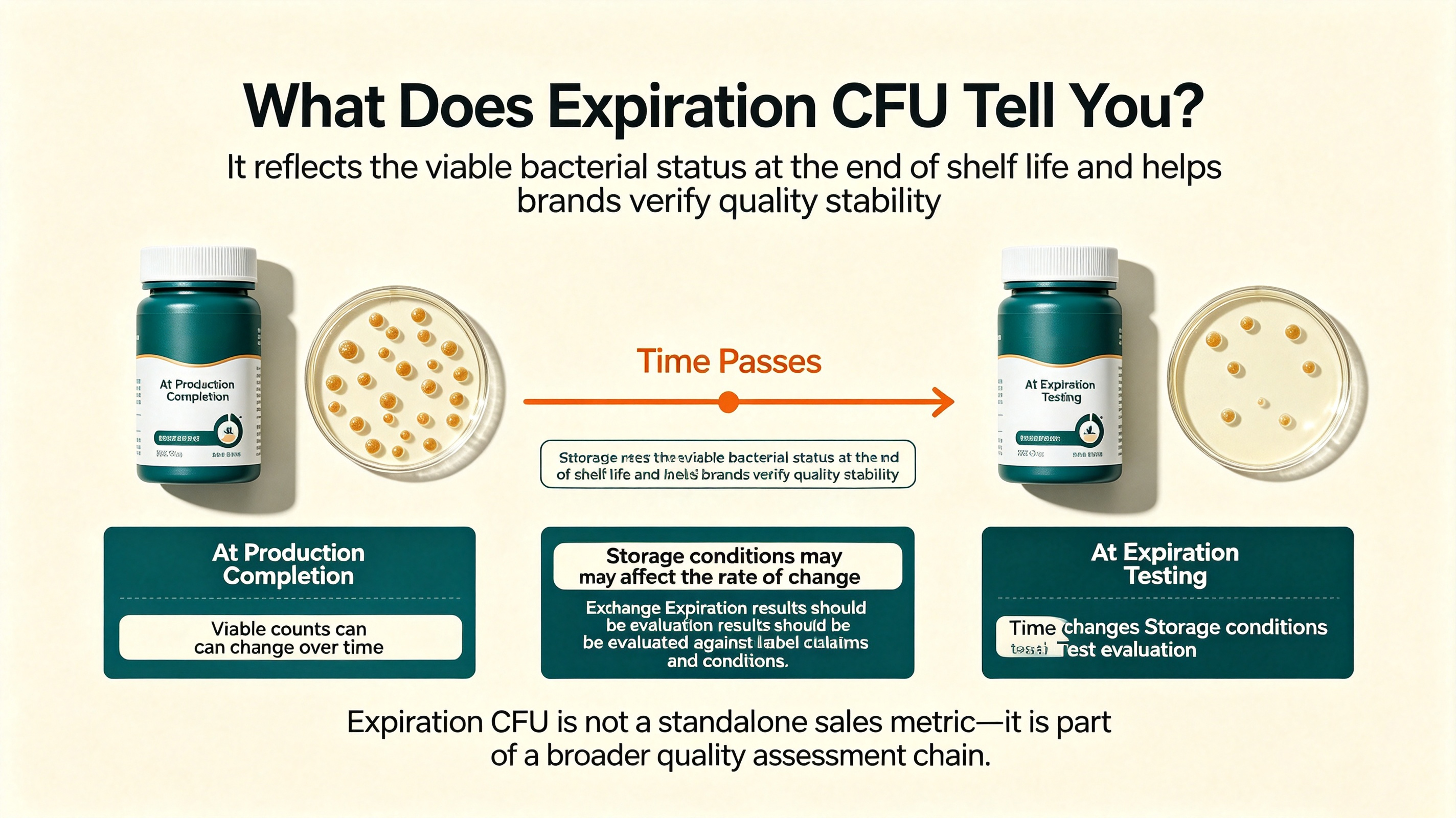
The CFU at the time of production is "ideal", while the CFU at the end of the shelf life is "realistic". Pets do not care about how much bacteria were added when the factory started production; they only care about how many live bacteria are in their stomach when they eat. When the entire industry is competing in number games, the brands that truly stand out are those that dare to promise "expiration Guaranteed Value" on the packaging and can provide experimental data to prove that the strain remains resilient during the shelf life.
Please remember: Hold onto "terminal value" in the specification sheet, "decay rate" in the COA, and "commentary" on the label" - these three tactics will be your strongest defense against the "high start and low end" efficacy trap.
WhatsApp: +8613455471839
Email: sales@koalapetbio.com


This website uses cookies to ensure you get the best experience on our website.



 Phone
Phone
Comment
(0)