

Open up the e-commerce platform and search for "pet gastrointestinal conditioning". You will see a large number of products that pack Digestive Enzymes and Probiotics in the same package. The page's promotional language is usually vague: "double protection", "synergistic effect", "one pill solves it all". But if you ask a question - why are these two things put together? Can they be taken separately? Many products themselves may not be able to answer this.
This article wants to clarify one thing: the Combination Formula of digestive enzymes and probiotics is meaningful under certain conditions, not just to make the ingredient list look good by forcing them together.
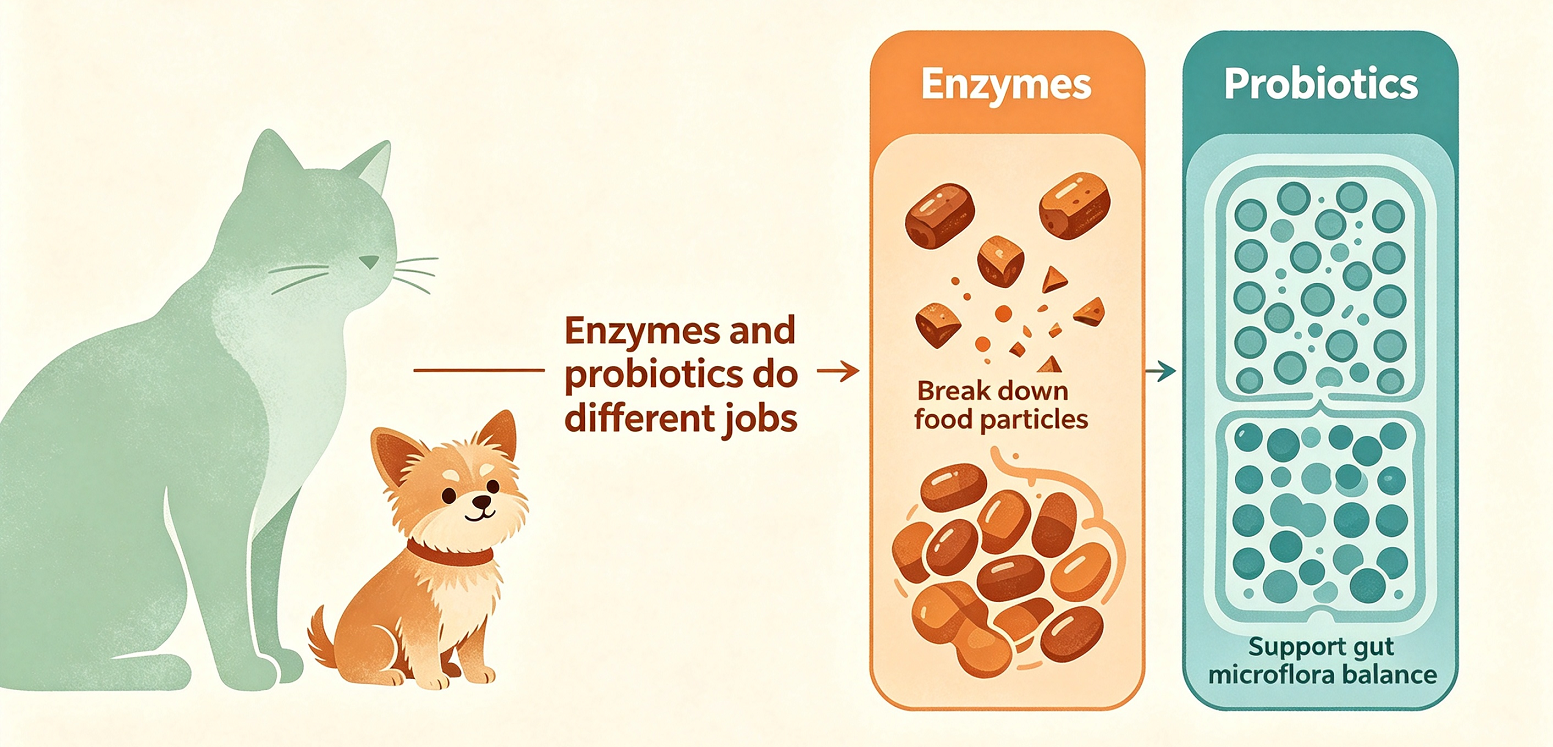
Digestive enzymes are "tools", while probiotics are "residents". This distinction is the starting point for understanding the logical combination.
The role of digestive enzymes is straightforward: they help break down food. Protease cuts proteins, amylase cuts starch, and lipase cuts fats. After entering the intestine, they start working when encountering the substrate and then exit with the feces, not colonizing. If a pet has insufficient pancreatic function, weak digestive ability, or food that is difficult to break down, supplementing exogenous digestive enzymes can directly improve the utilization rate of nutrients.
The logic of probiotics is completely different. They are live microorganisms, and their goal is to reach the intestine alive and stay there temporarily, through acid production, competing for attachment sites, regulating immunity, etc., to improve the intestinal environment. Probiotics do not directly break down the food you feed them; they affect the microecology in the intestine.
One does "digestion work", the other does "environment management". Their functions do not overlap, and theoretically they are complementary. But "theoretically complementary" and "it makes sense to put them together practically" are separated by a bunch of practical problems.
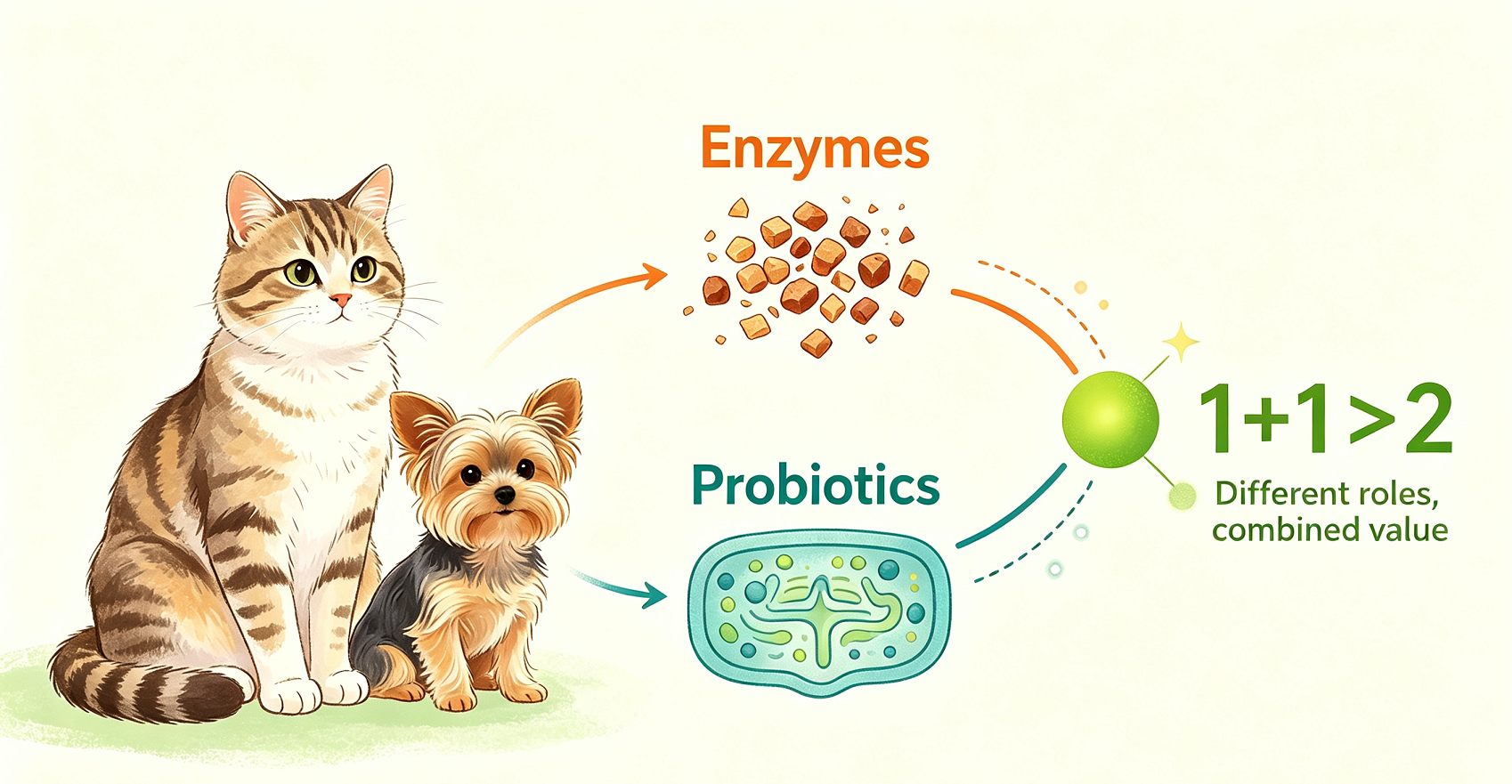
The combination formula is meaningful usually in the following scenarios.
Scenario One: There is a "relay relationship" between the substrate and the strain. Some combination designs aim to let enzymes break down large molecules first, providing easier-to-utilize nutrients for probiotics, or allowing probiotics to survive better in the environment after enzymatic breakdown. A study designed the process of enzymatic breakdown and probiotic fermentation as consecutive steps: first, use protease to hydrolyze the protein in meat powder, deactivate the enzyme, then inoculate lactoBacillus for fermentation, and finally the product's protein digestibility and viable bacteria count can be guaranteed. This "enzyme first, then bacteria" process logic is valid - enzymes are responsible for opening the road, and bacteria are responsible for occupying the position.
Scenario Two: Both are targeting different parts of the same problem. For example, if a pet has poor defecation, it may be due to insufficient digestion or a disrupted microbiota. If a product contains proteinase, amylase, and several strains of clearly having intestinal colonization ability such as spore-forming bacteria or lactobacillus, it covers both the "digestion end" and the "microecological end" paths. There was an experiment adding a compound probiotic and enzyme preparation to cat food, and after 63 days, the fecal condition of the test group improved significantly, and the apparent digestibility of nutrients also increased with the increase in the proportion of probiotics.
Scenario Three: There is clear evidence of synergy between a specific strain and a specific enzyme. This combination is the most persuasive, but it is the rarest. A study examined the effect of a combination of glucanase and Enterococcus faecalis on oral biofilms in dogs, finding that the combined use of the two could significantly reduce the total number of bacteria in the mouth and down-regulate the expression of virulence genes of Porphyromonas gingivalis. This is an example of enzyme and bacteria working together on the same target. But note: this evidence is strain-specific and cannot be directly generalized to "any probiotic + any enzyme".
In contrast, under what circumstances does the combination not make sense? If the selection of enzymes is merely the standard trio of "protease + amylase + lipase", and probiotics are merely labeled as "lactic acid bacteria" - with no logical sequence in terms of process or path design for addressing the same issue - then this combination is essentially "putting two individually marketable items into one bag".
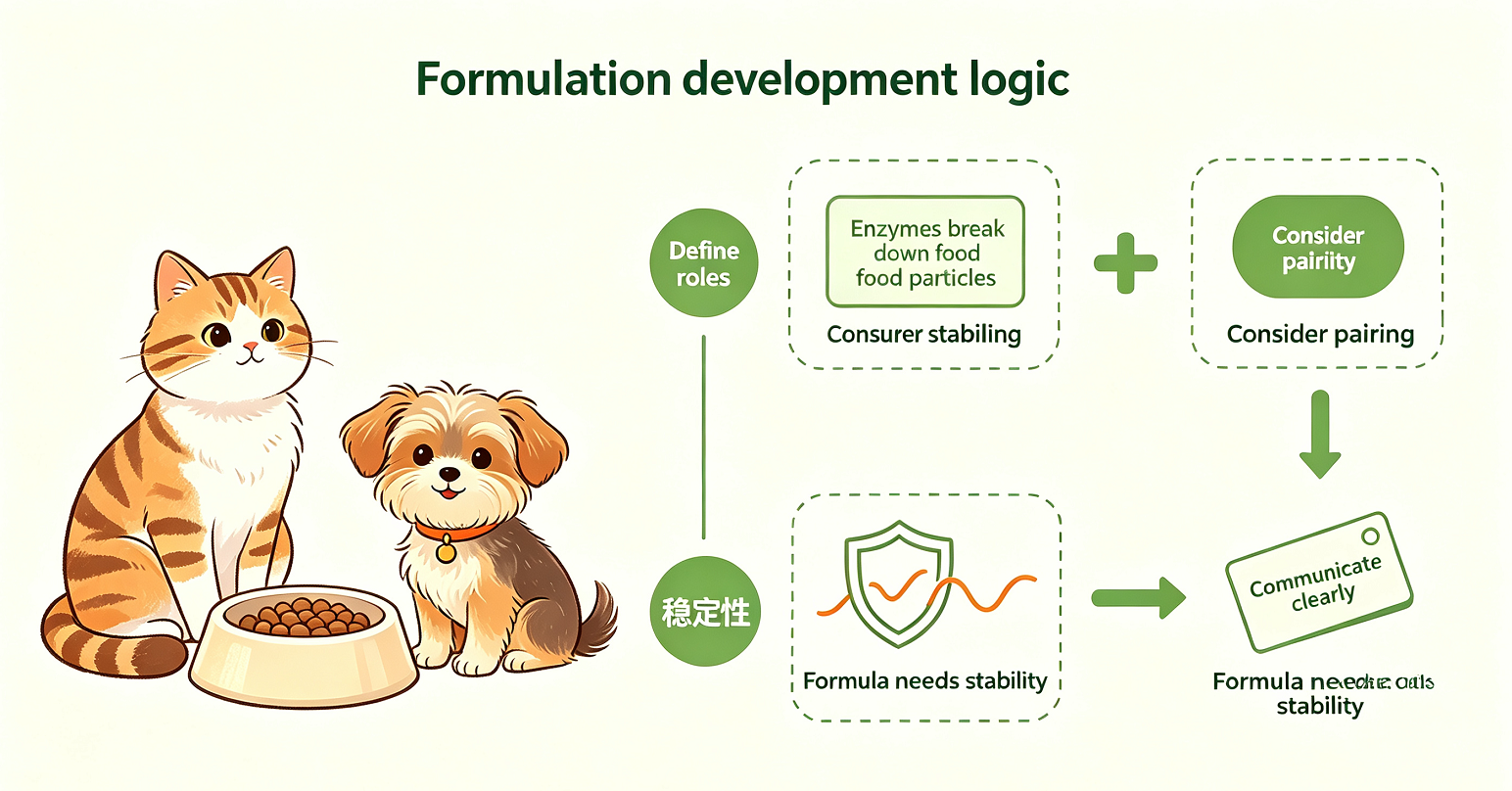
Enzymes and bacteria are both "fragile" substances, and their fragility directions are different.
Enzymes are afraid of heat, and so are bacteria, but with different thresholds.The activity of most feed enzymes begins to rapidly decline at 60–80°C, while some heat-resistant amylases can withstand temperatures above 100°C. Probiotics are more sensitive, and the nutritional cells rapidly lose their activity at 60°C or above, while the spore-forming ones have a slightly better tolerance, but it is also limited. If the product needs to undergo high-temperature processes such as extrusion or granulation, the combined formula should either select heat-resistant strains and enzymes, or need to be protected by coating.
Coating is a common solution, but it is costly. There is a patented design with a three-layer structure: the innermost layer is the enzyme core, the middle layer is the probiotic layer, and the outermost layer is coated with pH-responsive materials to protect the enzymes and bacteria in the acidic stomach environment and release them only in the intestinal tract. This design does indeed improve the survival rate of live bacteria and the intestinal release efficiency of enzymes, but the complexity of the process directly reflects in the cost. Most low-priced "enzyme + bacteria" products in the market will not have this level of protection.
The two may also drag each other during storage. Enzyme preparations usually require a lower water activity to maintain their activity, and probiotics are also afraid of moisture. However, if they coexist in the same powder package, the choice of carriers and excipients becomes a compromise solution, which may not be optimal for both. Some research has divided the probiotic and enzyme preparations into separate granulation areas, with the water activity controlled at 0.2 or below and moisture below 5% in the second area, aiming to provide each component with its own suitable microenvironment.
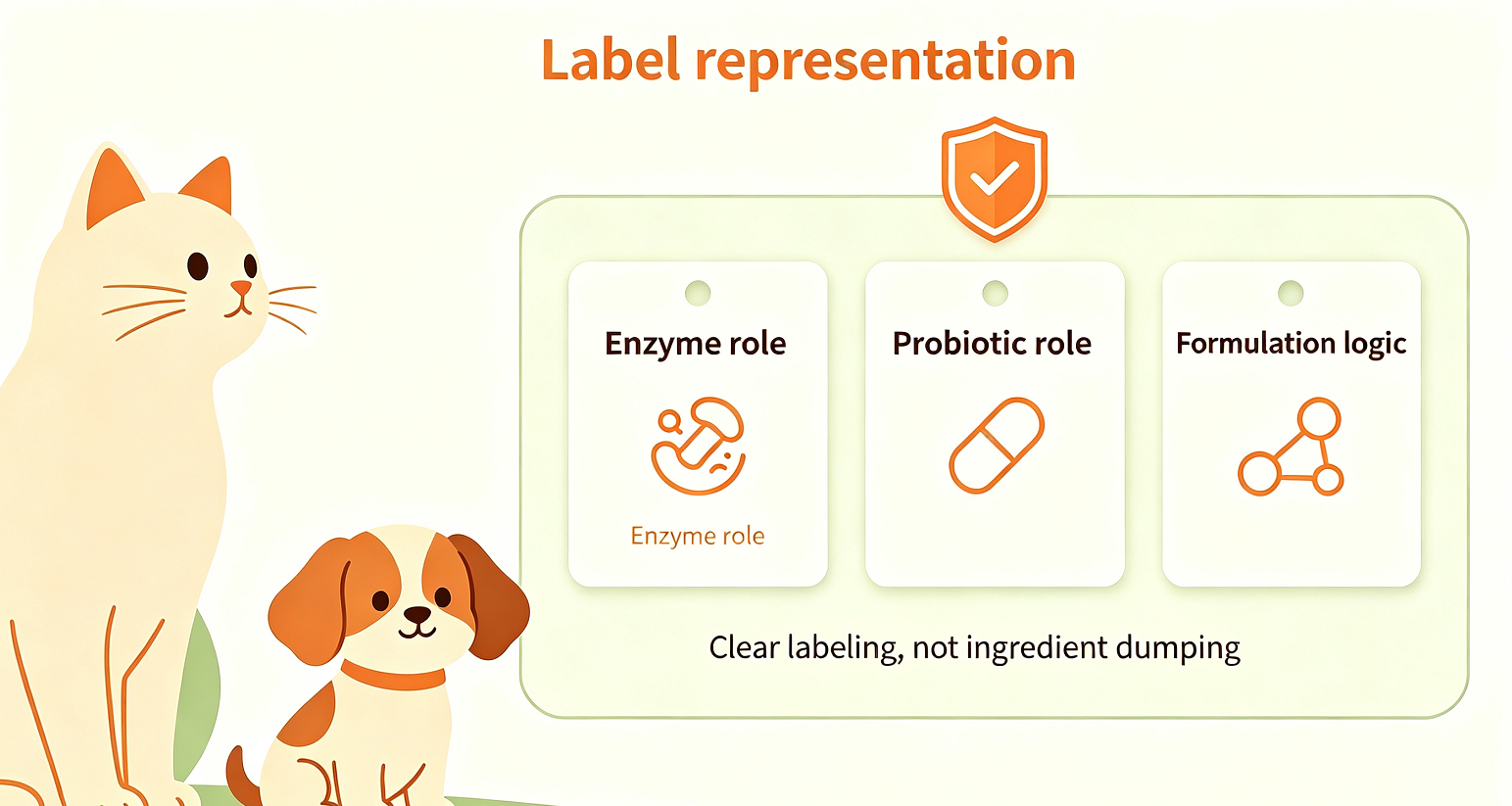
When looking at the label of an enzyme and bacteria combination product, there are several points worth noting.
Enzymes should be labeled with activity units, not just the name. According to the standard, the content of enzyme preparations should be expressed in enzyme activity units, such as U/g or U/mL. Just writing "protease" without its activity and "contains probiotics" without the number of bacteria is, in terms of information content, approximately zero. Good labels will clearly state: Protease (source strain) XX U/g.
Bacteria should be labeled with strain and live bacteria count. "Lactic acid bacteria" is a broad category, and the functional differences between different strains may be greater than those between cats and dogs. The label should at least show the specific strain name (such as "coagulating bacillus" instead of "bacillus") and the live bacteria count (CFU/g). The official association for feed management in the United States requires that if multiple microorganisms coexist, the strains should be listed in descending order of content.
Claims in combination must be supported by evidence. According to domestic regulations on pet feed labeling, all functional claims must be supported by evidence, including public publications, test reports, etc., and it is prohibited to make any claims for preventing or treating diseases. If a product claims to have "enzyme-bacteria synergy", it should be able to provide test data on the combined use of enzymes and the specific bacterial strain, rather than combining data on enzymes alone and data on bacteria alone as evidence.

The premise for the significance of a combination formula is not that "both things are useful", but that "they are more useful together than separately". This "more useful" can come from process relay (enzymatic hydrolysis followed by fermentation), target synergies (targeting different aspects of the same problem), or Formulation integration (co-release of encapsulated substances to reduce usage costs).
If none of these conditions are met, it may be more practical to purchase and administer them separately. Enzymes can be administered before meals, while probiotics can be taken between meals, each using their respective suitable carriers and dosages. This approach may not necessarily be less effective than a "two-in-one" supplement.
The "+ " on the ingredient list should not merely be a marketing addition.
WhatsApp: +8613455471839
Email: sales@koalapetbio.com


This website uses cookies to ensure you get the best experience on our website.



 Phone
Phone
Comment
(0)