

Against the backdrop of the sustained growth of the pet economy today, a growing number of entrepreneurs have entered the pet nutritional supplement sector. Given the high capital and time thresholds associated with building self-operated manufacturing facilities, the original equipment manufacturing (OEM) model has become the primary choice for the vast majority of brands. However, before initiating cooperation, brand owners are often confronted with a critical question: which of OEM, original design manufacturing (ODM), and white-label models is the most suitable for their brand?
These three models differ significantly in terms of formula ownership, development cycle, budget threshold, minimum order quantity (MOQ), and Product Differentiation, which directly impacts a brand's core competitiveness and launch strategy.

OEM (Original Equipment Manufacturing): The brand owner holds a mature formula or patented technology, and the contract manufacturer is only responsible for production in accordance with established standards. The brand owner takes charge of product design, raw material specifications, and process parameters, while the manufacturer acts solely as an executive party.
ODM (Original Design Manufacturing): The contract manufacturer is responsible for formula research and development (R&D) and product design, providing mature solutions for the brand owner to select from. The brand owner may propose adjustment requirements based on market feedback, but the dominance of R&D rests with the manufacturer.
White-label Model: The manufacturer utilizes pre-validated base formulas, and the brand owner only customizes the Packaging and labels; the product formula is completely fixed and unmodifiable.
This constitutes the most fundamental distinction among the three models.
OEM: The ownership of the formula belongs to the brand owner. As the brand's core asset, the formula can still be transferred to other manufacturers for production even after the cooperation is terminated, generating significant asset accumulation effects.
ODM: Formulas are generally developed by the contract manufacturer, and the brand owner obtains exclusive use rights, while the underlying technology of the formula is owned by the manufacturer. Intellectual property clauses must be clearly specified in the contract to prevent disputes.
White-label: The formula is fully owned by the contract manufacturer, and the same formula may be supplied to multiple brands. Brand owners have no exclusive barriers, and product differentiation is only reflected in packaging.
If a brand focuses on building long-term competitive moats, the OEM model offers the greatest advantages; if rapid market entry is the goal, ODM and white-label models can lower R&D thresholds.

The time costs of different models vary dramatically.
White-label Model: This is the fastest route. Since the formula is already mature, only packaging design and label filing are required, and products can generally be launched within 3 to 4 months.
ODM Model: The process includes requirement communication, formula sampling, sample testing and other links. If new raw material screening is involved, the process typically takes 4 to 8 months.
OEM Model: The timeline depends on the maturity of the brand's formula. If the formula is complete and raw material supply is stable, the cycle is controllable; if repeated debugging is required, the timeline may exceed that of ODM.
For brands that need to quickly validate market demand and seize market windows, white-label is the most economical option; for brands pursuing product uniqueness, sufficient time should be reserved for ODM or OEM.
The ranking of budget thresholds from lowest to highest is: white-label < ODM < OEM.
White-label: No investment in R&D or formula testing is required, and costs are concentrated in packaging customization. MOQ is usually the most flexible. Some manufacturers accept orders starting from hundreds of units, which is suitable for small-scale market testing.
ODM: Brands are required to cover Formula Development costs, which are amortized over the order. MOQ generally ranges from 1,000 to 3,000 units, making it suitable for mid-sized brands.
OEM: If the brand holds the formula independently and designates specific raw materials, the upfront R&D investment is low, but costs are incurred for formula validation and Stability testing. MOQ is determined by the manufacturer's production scheduling requirements, and is generally no lower than that of ODM.
It should be noted that differences in Contract Manufacturing quotations often stem from raw material grades, process technology, and Quality Control standards, rather than the model itself. Brand owners should conduct comprehensive evaluations instead of simply comparing prices.
White-label: It carries the highest risk of homogenization. The same formula is supplied to multiple brands, with no difference in the core product, so competition can only be carried out at the packaging design and marketing levels.
ODM: Moderate differentiation can be achieved. Brand owners can propose functional directions and dosage form preferences, and the manufacturer develops a customized solution based on these requirements. However, the "genetic" core of the formula still belongs to the manufacturer's technical system.
OEM: It offers the largest space for differentiation. Brand owners hold exclusive formulas or patented raw materials, endowing products with irreplicability and enabling the establishment of genuine technical barriers.
Against the backdrop of increasingly prominent homogenization in the current pet nutritional supplement market, the path to breakthrough lies in formula innovation and functional segmentation. If a brand positions itself as a high-end product or targets a specific functional niche, OEM or in-depth ODM is a necessary path; if it targets the mass cost-performance market, white-label is sufficient to meet demand.
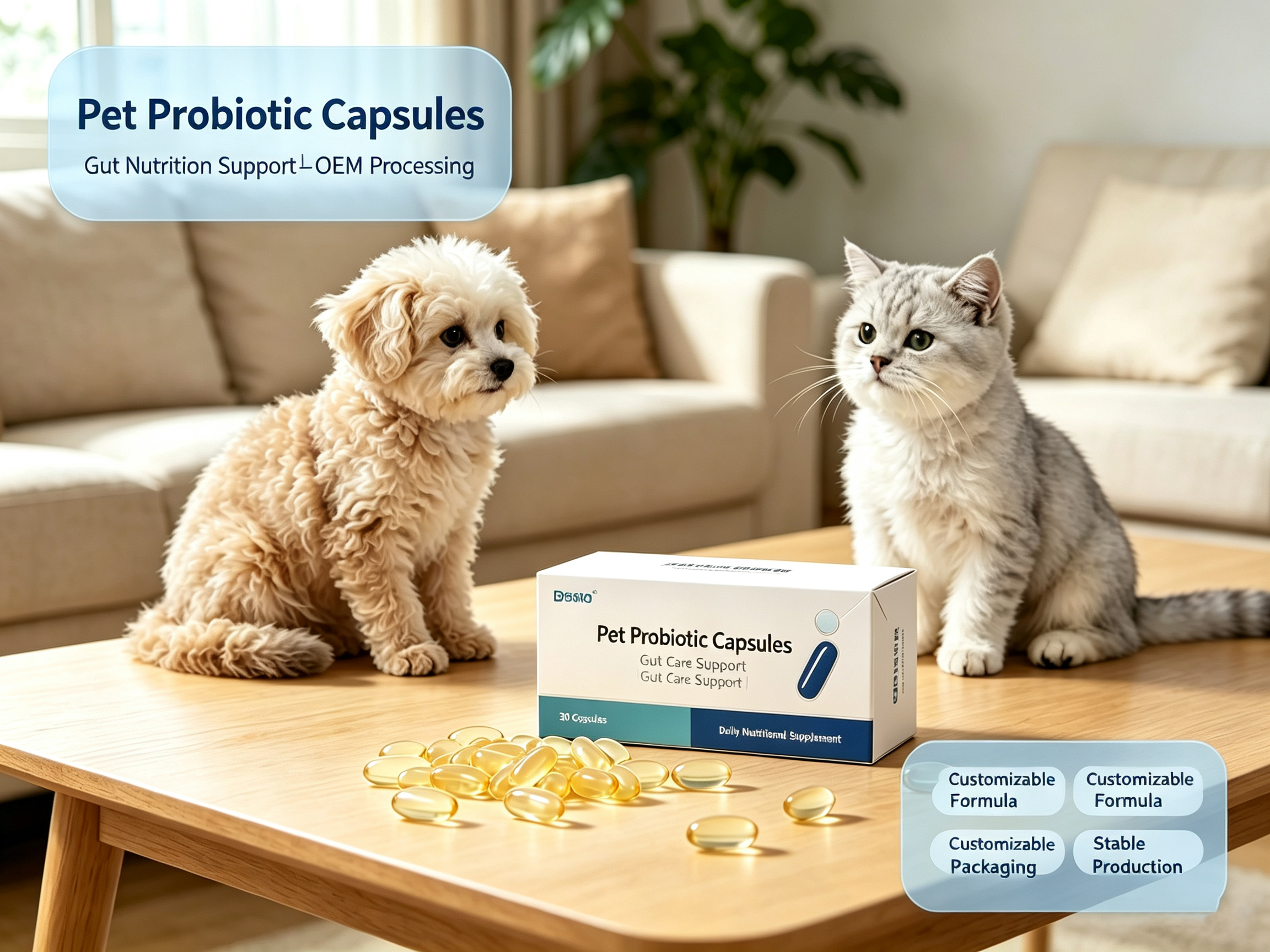
For Startup Brands with limited budgets that need to quickly test the market: The white-label model is preferred, which allows brands to quickly launch 1 to 2 SKUs with Low MOQ to validate market demand. After sales stabilize, brands can then shift to ODM to develop exclusive formulas.
For brands with mature formulas or patented technologies: OEM should be selected to keep R&D assets firmly in the brand's own hands and build long-term differentiation barriers.
For brands with certain capital strength that hope to own exclusive products but lack R&D capabilities: ODM should be selected. Brands should conduct in-depth communication with manufacturers on brand positioning and functional requirements to develop exclusive formulas, and must clearly specify formula use rights and confidentiality clauses in the contract.
Regardless of which model is selected, it is recommended that brand owners clarify product positioning, target channels and budget boundaries before launch, and conduct strict qualification reviews and on-site inspections of contract manufacturers. Amidst the fierce competition in the current pet nutritional supplement sector, brands that can achieve long-term development are those that have made solid efforts in supply chain selection and product capability refinement.
WhatsApp: +8613455471839
Email: sales@koalapetbio.com


This website uses cookies to ensure you get the best experience on our website.



 Phone
Phone
Comment
(0)